Sending a GIF Instead of a Text Is Now the Most Honest Thing You Can Do on a Dating App
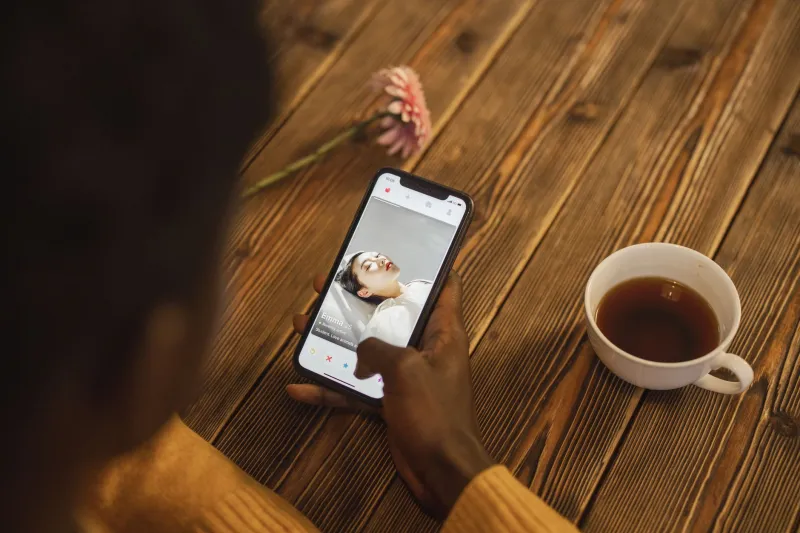
There's a moment every seasoned dating app user knows too well. You match with someone, you stare at the blank message box, and you type — then delete — some variation of "hey, how's your week going?" It's hollow. It's forgettable. And both of you know it.
So more and more people are skipping the words entirely.
Instead, they're sending a GIF.
Maybe it's the Schitt's Creek "I love this journey for me" clip in response to someone's chaotic travel story. Maybe it's a perfectly timed Michael Scott cringe loop when a conversation goes sideways in the best possible way. Whatever the source, the message lands differently. It lands real. And platforms like Hinge, Bumble, and Tinder have noticed — building GIF libraries, animated reaction features, and search-powered loop finders directly into their messaging interfaces.
The animated response has officially become a love language.
Why Words Keep Failing Us (and GIFs Keep Showing Up)
Typing is slow. Tone is invisible. And "lol" stopped meaning anything around 2014. The fundamental problem with flirting over text is that so much of what makes attraction feel like attraction — the timing, the expression, the shared reference — gets stripped away the moment it hits a message thread.
GIFs solve that in a way emojis never fully managed to. A looping clip carries context. It signals that you watched enough of the same shows, scrolled through enough of the same corners of the internet, to speak the same visual shorthand. That recognition — you know this thing I know — is essentially the digital equivalent of laughing at the same joke across a crowded room.
Psychologists who study digital communication have pointed to something called "emotional bandwidth" — the range of feeling that a given medium can actually transmit. Plain text has narrow bandwidth. A GIF of someone dramatically fainting in response to a compliment? Much wider. It's expressive, it's funny, and it's low-stakes enough that rejection doesn't sting the same way a heartfelt paragraph would.
How the Apps Built GIFs Into the Flirt Pipeline
Bumble integrated GIPHY's API into its messaging system years ago, but the way users are using that feature has evolved significantly. Early adopters treated it like a novelty. Now it's strategy.
Hinge went a step further by building GIF reactions directly into its prompt-and-response structure — the same mechanic that lets you "like" a specific photo or comment on a specific answer. You can now react to someone's profile content with an animated loop before you've even said a single word. It's the GIF as an opening move, a flirtatious first impression that arrives before any real conversation starts.
Tinder's GIF keyboard has been a staple for years, but the platform's data has repeatedly shown that opening messages with GIFs get higher response rates than plain text openers. That's not a small thing. In an environment where most opening messages go unanswered, animated content is apparently doing something right.
The theory among dating app strategists is simple: GIFs reduce the pressure. They're inherently playful. They signal that you're not taking yourself too seriously, which is — ironically — one of the most attractive things you can communicate in the early stages of connecting with someone.
The Unspoken Rules of GIF Flirting
Like any language, GIF-based flirting has developed its own grammar. Use it wrong and you'll know immediately — either by the awkward silence that follows or by the politely confused response that makes it clear the reference didn't land.
A few principles that frequent dating app users swear by:
Relevance beats randomness. A GIF that directly responds to something the other person said shows you were actually paying attention. A random funny loop dropped into a conversation with no context just reads as noise.
Timing is everything. This is true in comedy and it's true in flirting. A GIF that arrives three messages too late loses most of its power. The loop has to feel like a reaction, not an afterthought.
Don't over-GIF. Sending five animated responses in a row signals one of two things: that you're incredibly nervous, or that you've decided humor is a shield rather than a bridge. Either way, the other person notices.
Niche beats mainstream. Sending the same SpongeBob meme that everyone has seen a thousand times doesn't tell anyone anything about you. But pulling out a reference from a deep-cut sitcom episode or an obscure sports moment? That's personality. That's something to talk about.
What It Actually Communicates (Beyond the Joke)
Here's what's interesting about the GIF-as-flirting phenomenon: it's not really about the GIF itself. It's about what choosing that specific loop reveals about a person.
When you search for and send a GIF, you're making a series of small creative decisions. You're deciding what category of humor fits this moment. You're deciding how much personality to show. You're betting that the other person will get the reference. Each of those micro-decisions adds up to something that feels, to the person on the receiving end, like genuine self-expression.
That's the thing plain text often fails to deliver in early-stage digital conversation — a sense of who you actually are. A well-chosen GIF shortcuts that problem. It says: here is my sense of humor, here is what I'm referencing, here is how I see this moment we're sharing. Do with that what you will.
For a lot of people, it turns out, that's more romantic than a carefully crafted paragraph.
The GIF Library as a Dating Profile Extension
Some power users have taken this further. They've essentially curated mental (or actual) libraries of go-to GIFs for specific conversational scenarios — the "I'm interested" loop, the "this is hilarious" loop, the "okay you got me" loop. It sounds calculated, but in practice it's not that different from knowing your best jokes or your most charming stories.
Platforms like Gifsom are increasingly where people do this kind of browsing — not just searching for one specific GIF in the moment, but exploring categories and moods until something clicks. The search becomes part of the fun. And the right loop, when you find it, feels like a small discovery worth sharing.
That's the thing about GIFs and romance that nobody really talks about: the act of finding the right one is itself an act of attention. You thought about this person long enough to go looking. You cared enough to find the right loop, not just the first one.
In the swipe-fast, move-on culture of modern dating apps, that kind of small deliberateness stands out more than you'd think.
The Loop Keeps Going
None of this means GIFs have replaced real conversation or genuine connection. They're a starting point, a warm-up, a way of lowering the temperature on something that can feel impossibly high-stakes.
But the fact that animated responses have become a legitimate flirting tool — built into app infrastructure, studied by strategists, and embraced by millions of actual users — says something worth paying attention to. We've always communicated attraction through shorthand. Looks, gestures, shared laughs. The GIF is just the latest version of that impulse, optimized for a world where the first impression happens on a 6-inch screen.
Find the right loop. Send it at the right moment. See what loops back.